What is Sets?

A set is a collection of objects that have something in common or follow a rule. The objects in the set are called its element. Curly braces are used to indicate that the objects written between them belong to a set. Every object in a set is unique. It is not necessary to list every object in the set. Instead, the rule that the objects follow can be given in the braces. We can define a set by listing its elements or by describing its elements. The latter method is useful when working with large sets.
So what does this have to do with mathematics? When we define a set, all we have to specify is a common characteristic. Who says we can't do so with numbers?
When we say that A is a subset of B, we write A
This is probably the weirdest thing about sets.
So let's go back to our definition of subsets. We have a set A. We won't define it any more than that, it could be any set. Is the empty set a subset of A?
Question 1:
A is the set of factors of 12.
Which one of the following is not a member of A?
A set is a collection of objects that have something in common or follow a rule. The objects in the set are called its element. Curly braces are used to indicate that the objects written between them belong to a set. Every object in a set is unique. It is not necessary to list every object in the set. Instead, the rule that the objects follow can be given in the braces. We can define a set by listing its elements or by describing its elements. The latter method is useful when working with large sets.
Set Symbols


A set is a collection of things, usually numbers. We can list each element (or "member") of a set inside curly brackets like this:
Notation
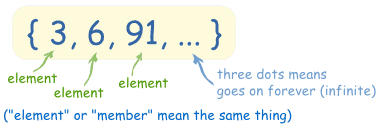
There is a fairly simple notation for sets. We simply list each element (or "member") separated by a comma, and then put some curly brackets around the whole thing:
The curly brackets { } are sometimes called "set brackets" or "braces".
This is the notation for the two previous examples:
{socks, shoes, watches, shirts, ...}
{index, middle, ring, pinky}
{index, middle, ring, pinky}
Notice how the first example has the "..." (three dots together).
The three dots ... are called an ellipsis, and mean "continue on".
Numerical Sets
So what does this have to do with mathematics? When we define a set, all we have to specify is a common characteristic. Who says we can't do so with numbers?
Set of even numbers: {..., -4, -2, 0, 2, 4, ...}
Set of odd numbers: {..., -3, -1, 1, 3, ...}
Set of prime numbers: {2, 3, 5, 7, 11, 13, 17, ...}
Positive multiples of 3 that are less than 10: {3, 6, 9}
And the list goes on. We can come up with all different types of sets.
There can also be sets of numbers that have no common property, they are just defined that way. For example:
{2, 3, 6, 828, 3839, 8827}
{4, 5, 6, 10, 21}
{2, 949, 48282, 42882959, 119484203}
Are all sets that I just randomly banged on my keyboard to produce.
Set of odd numbers: {..., -3, -1, 1, 3, ...}
Set of prime numbers: {2, 3, 5, 7, 11, 13, 17, ...}
Positive multiples of 3 that are less than 10: {3, 6, 9}
{4, 5, 6, 10, 21}
{2, 949, 48282, 42882959, 119484203}
Universal Set

At the start we used the word "things" in quotes.
We call this the universal set. It's a set that contains everything. Well, not exactly everything. Everything that is relevant to our question.
Then our sets included integers. The universal set for that is all the integers.
In fact, when doing Number Theory, this is almost always what the universal set is, as Number Theory is simply the study of integers.
We call this the universal set. It's a set that contains everything. Well, not exactly everything. Everything that is relevant to our question.
In fact, when doing Number Theory, this is almost always what the universal set is, as Number Theory is simply the study of integers.
Some More Notation

When talking about sets, it is fairly standard to use Capital Letters to represent the set, and lowercase letters to represent an element in that set.
So for example, A is a set, and a is an element in A. Same with B and b, and C and c.
Example: Set A is {1,2,3}. We can see that 1  A, but 5
  A
A
| When talking about sets, it is fairly standard to use Capital Letters to represent the set, and lowercase letters to represent an element in that set. So for example, A is a set, and a is an element in A. Same with B and b, and C and c. Example: Set A is {1,2,3}. We can see that 1 A, but 5 A |
Equality
Two sets are equal if they have precisely the same members. Now, at first glance they may not seem equal, so we may have to examine them closely!
And the equals sign (=) is used to show equality, so we write:
A = B
Subsets
When we define a set, if we take pieces of that set, we can form what is called a subset.
Example: the set {1, 2, 3, 4, 5}
In general:
A is a subset of B if and only if every element of A is in B.
Example: Is A a subset of B, where A = {1, 3, 4} and B = {1, 4, 3, 2}?
Let's try a harder example.
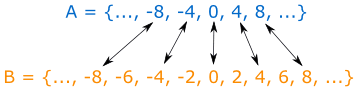
Example: Let A be all multiples of 4 and B be all multiples of 2. Is A a subset of B? And is B a subset of A?
Proper Subsets
So doesn't that mean that A is a subset of A?
This doesn't seem very proper, does it? We want our subsets to be proper. So we introduce (what else but) proper subsets.
A is a proper subset of B if and only if every element in A is also in B, and there exists at least one element in B that is not in A.
This little piece at the end is only there to make sure that A is not a proper subset of itself. Otherwise, a proper subset is exactly the same as a normal subset.
Example:
Example:
Notice that if A is a proper subset of B, then it is also a subset of B.
Even More Notation
When we say that A is a subset of B, we write A  B.
B.
Or we can say that A is not a subset of B by A  B ("A is not a subset of B")
When we talk about proper subsets, we take out the line underneath and so it becomes A  B or if we want to say the opposite, A
  B.
B.
Empty (or Null) Set
This is probably the weirdest thing about sets.
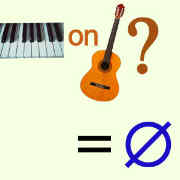 As an example, think of the set of piano keys on a guitar.
"But wait!" you say, "There are no piano keys on a guitar!"
And right you are. It is a set with no elements.
This is known as the Empty Set (or Null Set).There aren't any elements in it. Not one. Zero.
It is represented by 
Or by {} (a set with no elements)
Some other examples of the empty set are the set of countries south of the south pole.
So what's so weird about the empty set? Well, that part comes next.
Empty Set and Subsets
So let's go back to our definition of subsets. We have a set A. We won't define it any more than that, it could be any set. Is the empty set a subset of A?
Going back to our definition of subsets, if every element in the empty set is also in A, then the empty set is a subset of A. But what if we have no elements?
It takes an introduction to logic to understand this, but this statement is one that is "vacuously" or "trivially" true.
A good way to think about it is: we can't find any elements in the empty set that aren't in A, so it must be that all elements in the empty set are in A.
So the answer to the posed question is a resounding yes.
The empty set is a subset of every set, including the empty set itself.
Order
No, not the order of the elements. In sets it does not matter what order the elements are in.
When we say "order" in sets we mean the size of the set.
Just as there are finite and infinite sets, each has finite and infinite order.
For finite sets the order is the number of elements.
For infinite sets, all we can say is that the order is infinite. Oddly enough, we can say with sets that some infinities are larger than others, but this is a more advanced topic in sets.
When we say "order" in sets we mean the size of the set.
Common Symbols Used in Set Theory
Symbols save time and space when writing. Here are the most common set symbols
In the examples C = {1,2,3,4} and D = {3,4,5}
| Symbol | Meaning | Example |
|---|---|---|
| { } | Set: a collection of elements | {1,2,3,4} |
| A ∪ B | Union: in A or B (or both) | C ∪ D = {1,2,3,4,5} |
| A ∩ B | Intersection: in both A and B | C ∩ D = {3,4} |
| A ⊆ B | Subset: A has some (or all) elements of B | {3,4,5} ⊆ D |
| A ⊂ B | Proper Subset: A has some elements of B | {3,5} ⊂ D |
| A ⊄ B | Not a Subset: A is not a subset of B | {1,6} ⊄ C |
| A ⊇ B | Superset: A has same elements as B, or more | {1,2,3} ⊇ {1,2,3} |
| A ⊃ B | Proper Superset: A has B's elements and more | {1,2,3,4} ⊃ {1,2,3} |
| A ⊅ B | Not a Superset: A is not a superset of B | {1,2,6} ⊅ {1,9} |
| Ac | Complement: elements not in A | Dc = {1,2,6,7} When  = {1,2,3,4,5,6,7} = {1,2,3,4,5,6,7} |
| A − B | Difference: in A but not in B | {1,2,3,4} − {3,4} = {1,2} |
| a ∈ A | Element of: a is in A | 3 ∈ {1,2,3,4} |
| b ∉ A | Not element of: b is not in A | 6 ∉ {1,2,3,4} |
| ∅ | Empty set= {} | {1,2} ∩ {3,4} = Ø |
| Universal set: set of all possible values (in the area of interest) | |
| P(A) | Power Set: all subsets of A | P({1,2}) = { {}, {1}, {2}, {1,2} } |
| A = B | Equality: both sets have the same members | {3,4,5} = {3,4,5} |
| A×B | Cartesian Product: set of ordered pairs from A and B | {1,2} × {3,4} = {(1,3), (1,4), (2,3), (2,4)} |
| |A| | Cardinality: the number of elements of set A | |{3,4}| = 2 |
| | | Such that | { n | n > 0 } = {1,2,3,...} |
| : | Such that | { n : n > 0 } = {1,2,3,...} |
| ∀ | For All | ∀x>1, x2>x |
| ∃ | There Exists | ∃ x | x2>x |
| ∴ | Therefore | a=b ∴ b=a |
 | Natural Numbers | {1,2,3,...} or {0,1,2,3,...} |
 | Integers | {..., -3, -2, -1, 0, 1, 2, 3, ...} |
 | Rational Numbers | |
 | Algebraic Numbers | |
 | Real Numbers | |
 | Imaginary Numbers | 3i |
 | Complex Numbers | 2 + 5i |
Here is the video of sets:
-EXERCISE-
!GOOD LUCK!
Question 1:
A is the set of factors of 12.
Which one of the following is not a member of A?
Question 2:
X is the set of multiples of 3
Y is the set of multiples of 6
Z is the set of multiples of 9
Which one of the following is true?
(⊂ means "subset")
Y is the set of multiples of 6
Z is the set of multiples of 9
Which one of the following is true?
(⊂ means "subset")
Question 3:
A = {a, b, c, d}
How many subsets does the set A have?
How many subsets does the set A have?



![[IMAGE]](https://lh3.googleusercontent.com/blogger_img_proxy/AEn0k_vQlLf37sjPwsND3nr8DTwtym-Tnq5rz6KNJqJsyN30S7XvUQ-oGRvrUYcpSisV4eMEVhw5vvEPTLUY0ul4Gd4IWdUoXXvdUlOCp5TKGjhp_d2xcSv7hLBa_fMbXemNljTz=s0-d)


